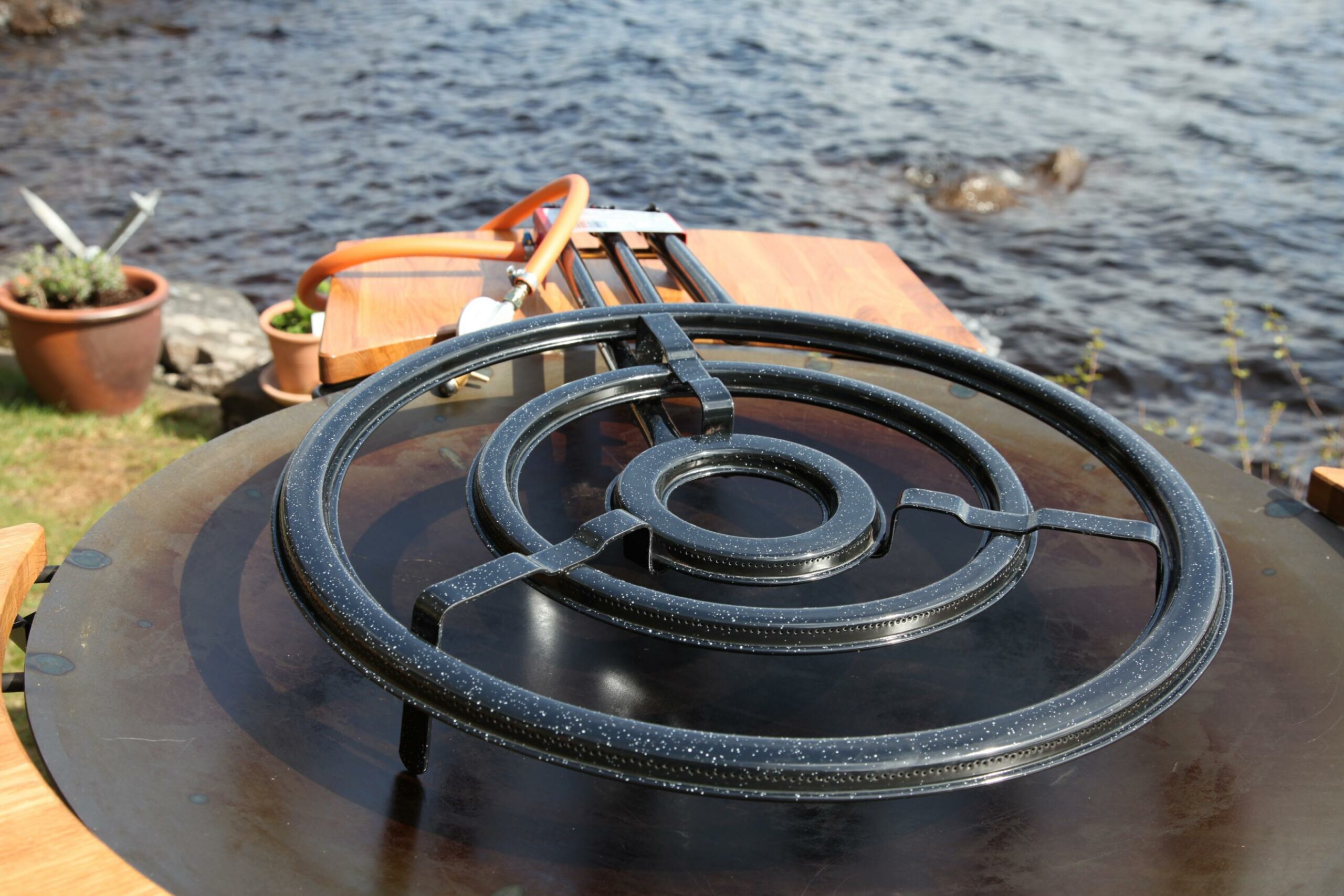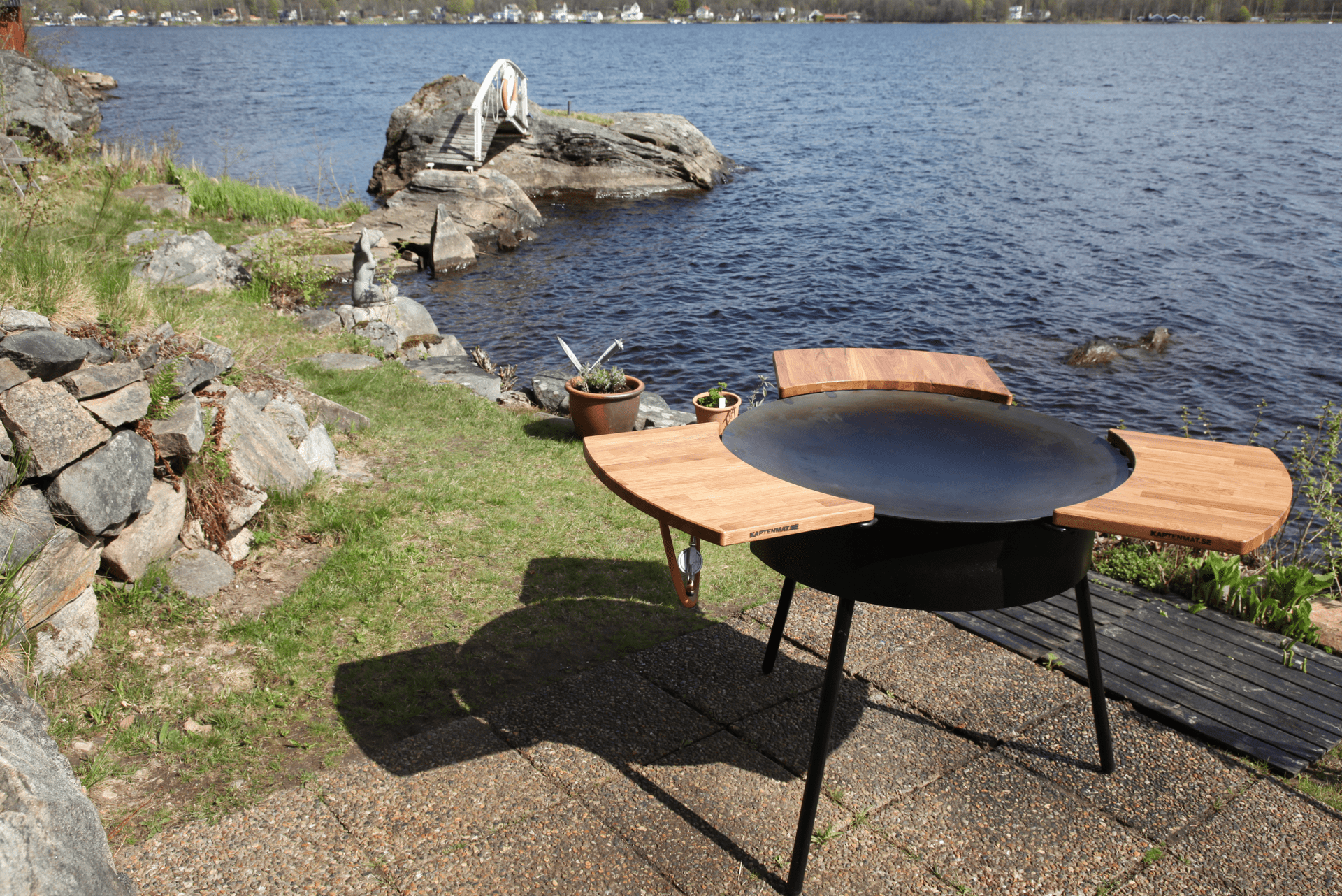

The griddle comes with three sturdy legs and the market's most efficient burner with a diameter of 60cm. Assembly is easy and follow these steps.
Every two people and one holds the frying pan in a vertical position. Insert each leg with the plastic plug towards the ground. Tighten the legs very carefully by hand.
Hook the burner into the three fasteners on the underside of the skull cap.
Then turn the roasting pan upside down on its legs. Clear!
Assemble and connect your regulator set to the burner
Start by threading the hose clamps onto the hose
Twist and push one end of the hose into the burner and tighten the hose clamp. The hose can be perceived as too small, but just try to "screw" it.
Twist and push the other hose end into the regulator and tighten the hose clamp.
Connect the regulator to the gas tube and open up the gas flow a maximum of one turn.
Turn the controls on the burner to maximum flow (9 o'clock)
Light the outermost ring with a long lighter type BIC "Mega lighter". Normally, the flame "jumps" on and lights up the other two rings, but sometimes they may need help with the lighting.
When all are lit, reduce gas flow to minimum (at 7 o'clock)
Now you are ready to start cooking. Easily adjust between maximum and minimum but also sometimes turn off some of the three burner rings.
Learn to master the heat
Learning to regulate the heat is probably the biggest challenge with cooking on a grill. There are so many factors that affect how much heat you need to add, such as the dish you are cooking, the season - cold or hot outside, a windy day makes the flame a little uneasy even if it doesn't go out.
Get to know your frying pan and go by feel. Turn off the largest ring if you don't cook a lot and use the outermost decimeters for keeping warm. Most of the time, turning the gas flow to minimum (at 7 o'clock) is sufficient.
Good luck!
The frying pan itself, i.e. the surface you fry on, must always be burnt in before you can cook. It is a simple procedure but is a dirty and hot job that will take you between 30-60 minutes. Stand outside on a lawn or in a place where you won't be sad if grease gets on the ground. Because it would be a shame if it got on your new terrace floor.
Do this:
I usually always recommend to burn the frying pan with an animal fat such as tallow or lard. In my local store there is Jureskog's tallow, which is absolutely excellent. If you find a piece of pork rind at the butcher, put it in as well. Use work gloves and avoid inhaling the fumes.
Light all the burner rings at full power.
Put a packet of tallow in the really hot frying pan.
Spread the fat around the entire surface using a stainless steel trowel with a wooden handle.
Burn and work with the fat until the fat chars and turns into a solid mass.
Scrape out the crumbly and burnt fat.
Repeat the procedure one more time.
Then turn off the grill and let it cool. Pour in 1 dl of rapeseed oil and spread over the entire frying surface. Dry with paper towels.
Now your frying pan is finished and ready to use. The frying surface only gets better and better with time.
How to take care of your cutting boards
Our cutting boards are made of laminated oak – a living material which reacts to moisture, heat and dehydration.
Oiling – the most important thing of all
A wooden cutting board must be oiled.
Oiled several times when new
Then regularly as needed
A dry board will crack – sooner or later
Does the board feel dry or dull? Then it's time.
Dish – quick in, quick out
Rinse or wash by hand
Warm water, mild detergent
Never dishwasher
Always dry the board immediately afterwards.
Storage – let it breathe
Store upright or on edge
Air should reach both sides
Avoid radiators, underfloor heating and direct sunlight.
Uneven drying creates cracks.
Good to know
Cracks and warping are almost always caused by lack of oiling or incorrect storage – not on the material.
Cutting boards made of glued oak require regular maintenance. Complaints due to lack of oiling or improper care will not be accepted.
Neither the calotte in which you fry nor the cutting boards must be stored in a humid environment. Therefore, it is strongly recommended that you purchase a cover that is completely waterproof and UV resistant for the best protection.
Very simply, you unhook the three cutting boards and place them in the cold frying pan. Then pull on the cover and store the grill outside until the next time you need to use it. If you only use the grill during the summer season, you must store it indoors during the winter in a dry place.
Your frying pan must be treated like a cast-iron pan, which means that you absolutely must not use washing-up liquid when cleaning, but only water. Scrape out with a stainless steel wide spatula with a wooden handle in dimensions between 15–25 cm.
How to burn in the frying panHow to burn in the frying panHow to burn in the frying panHow to burn in the frying panHow to burn in the frying panHow to burn in the frying panHow to burn in the frying panHow to burn in the frying pan
How to burn in the frying pan
See how to burn in the griddle on our YouTube channel.